

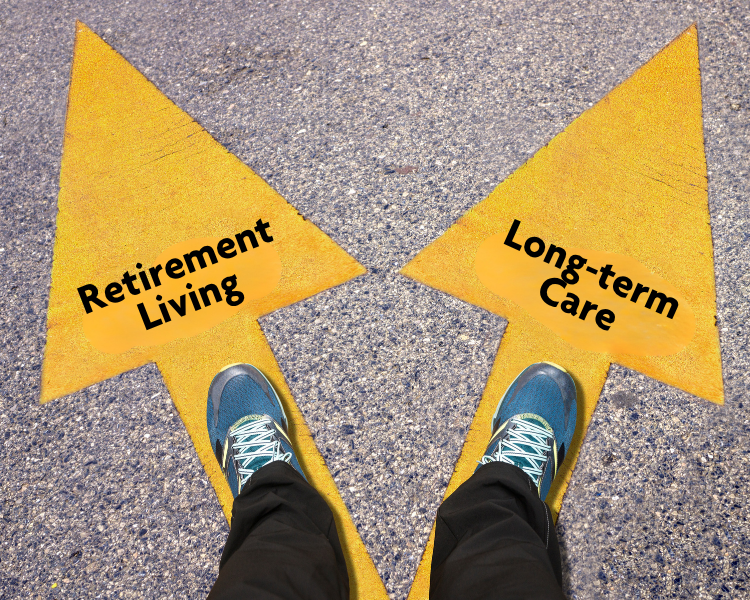
One of the first questions families ask us is:
"Should Mom go into long-term care?"
But after we spend a few minutes talking about their situation, we often discover they're actually describing retirement living.
It's one of the biggest misconceptions we see.
Many people use the terms retirement home, nursing home, long-term care and facility (we don’t like that “f” word) interchangeably, but they are very different types of housing, with different care models, costs, eligibility requirements, and admission processes.
Understanding the difference can save your family time, reduce stress, and help you make more informed decisions.
A retirement residence (also called a retirement home or retirement community) is a privately operated residence where older adults rent a suite and choose the services they need.
Many people picture retirement living as being only for active seniors who want meals and activities.
While that's certainly true for some residents, today's retirement communities often provide much more.
Depending on the residence, services may include:
Every residence is different, which is why it's important to understand what each community can and cannot provide.
Long-term care homes are designed for people with complex health needs who require ongoing nursing care and support with most activities of daily living. Complex health needs might include mobility, cognitive concerns, violent behaviour, specialized care needs, or a combination of these.
In long-term care, the Government of Ontario funds the care that residents receive. Residents contribute toward the cost of their accommodation (their room and meals), with rates set by the province.
Myth: Long-term care is "free."
Reality: The care is funded by the Government of Ontario, but residents pay a regulated accommodation fee for their room and meals. If someone qualifies for a basic room and has a low income, they may be eligible for a rate reduction.
Admission is coordinated through Ontario Health atHome, and individuals must complete an assessment to determine eligibility. Families cannot apply directly to a long-term care home.
Because demand is high, many homes have significant wait times.
Many families assume that if their loved one needs personal care, mobility assistance, or memory support, they must move directly into long-term care.
In many situations, that's simply not the case.
In fact, we have spoken with families who have been urged by medical staff to explore options other than long-term care, partly because that system is overwhelmed, and partly because families may be assuming that ltc is the only option.
Retirement residences have evolved significantly over the years and many now support residents with surprisingly high care needs, including lifts and secured memory care.
For someone who values independence but needs increasing assistance, retirement living may provide the right balance of support, flexibility, and lifestyle.
That doesn't mean retirement living is always the right choice.
It means it's important not to rule it out simply because your loved one needs care.
Retirement Living
Privately funded
Monthly rent plus care services
Apply directly to the residence
Usually available more quickly
Flexible care packages that can often increase over time
Greater emphasis on independence, lifestyle, and choice
Long-Term Care
Publicly funded care
Residents pay accommodation; care is funded
Apply through Ontario Health atHome
Wait times may be months or years, depending on the home
Designed for people with complex care needs requiring ongoing nursing support
Greater emphasis on medical care and daily assistance
The answer depends on much more than a diagnosis.
We look at questions like:
Sometimes the answer is retirement living.
Sometimes it's long-term care.
Sometimes it's staying at home with additional supports.
And sometimes it's creating a plan now, even if a change or move isn't needed yet.
Choosing between retirement living and long-term care isn't about finding the "better" option.
It's about finding the right option for your loved one's needs, goals, and future.
At Tea & Toast, we help families understand the differences, explore realistic options, and develop a plan that fits their unique situation.
Making confident decisions starts with understanding your choices.
Every family's situation is unique. During a complimentary Discovery Call, we'll learn more about your loved one's needs, answer your initial questions, and help determine the most appropriate next step, whether that's planning ahead, exploring retirement living, understanding long-term care, or simply learning more about your options.
Book your complimentary Discovery Call today.


Subscribe to our mailing list to receive the latest news and updates